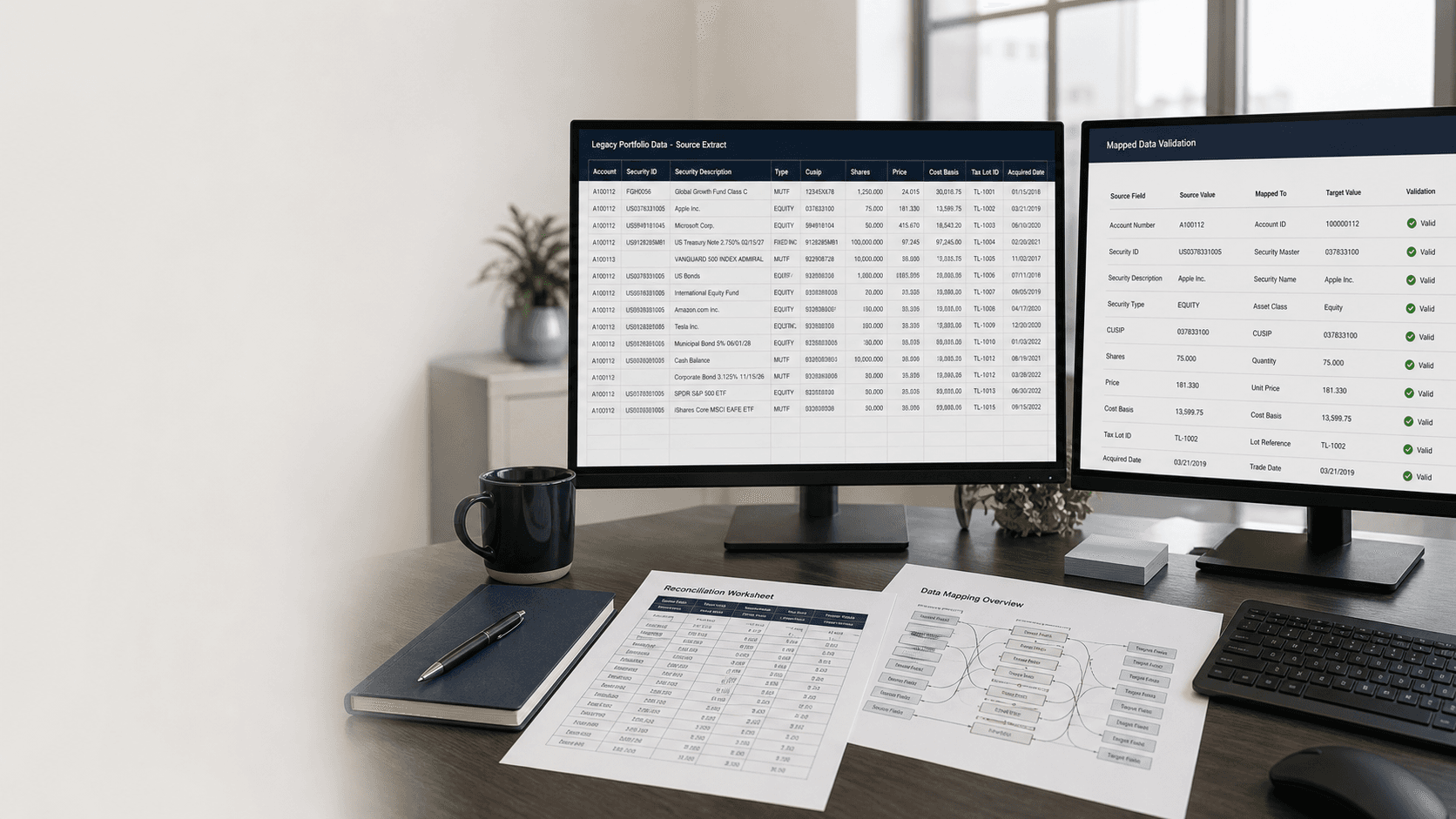
CSSI helps investment firms connect source data with their portfolio management environment. We review direct-feed and aggregation options, account and security mappings, refresh requirements, and reconciliation. Start with the custodians, accounts, and outputs your firm needs to support.
Direct-feed and aggregation requirements reviewed against actual sources
Account mappings, data dates, and exception ownership defined together
A representative feed checked before broader portfolio-system integration
From a CSSI customer engagement
See data feeds, reconciliation, and reports working together
A published CSSI engagement describes moving a Trust 3000 client's reconciliation process to CyGem, using CSSI data feeds and custom reporting. It illustrates an agreed operational scope; each firm needs its own review.
Financial data aggregation collects account information from multiple sources for use in another environment. For an investment firm, the requirement may be holdings, activity, prices, or tax lots feeding portfolio accounting and reports. Define the required records and history before selecting a connection method.
Scope implementation and ongoing feed work
CSSI maintains direct-feed capabilities and works with aggregation partners, including Morningstar ByAllAccounts. The project should confirm source coverage, permissions, fields, format, and refresh timing. Translation, mapping, portfolio-system loading, and reconciliation are work to agree alongside the connection.
Feed checklist
What to confirm before a data feed becomes operational
Use a representative account at each required source. Provider coverage and available records must be confirmed for that source and connection method.
Scroll across to review all three columns.
What to confirm before a data feed becomes operational
Feed requirement
Confirm during scoping
Evidence from the sample
Source and account coverage
The institution, account types, permitted connection, and any records outside coverage.
The intended accounts appear in the feed and coverage gaps have an agreed treatment.
Data fields and history
Positions, transactions, prices, tax lots, required history, and any missing fields.
The delivered fields and periods support the target accounting or reporting workflow.
Permissions and connection ownership
Who establishes the permitted connection and handles renewal, reconnection, or access changes.
The source can be accessed through the agreed method, with a named owner for connection exceptions.
Refresh timing and reporting basis
Expected arrival, source as-of date, trade or settlement basis, and handling of delayed records.
The feed meets the agreed reporting window or flags a late or incomplete source for review.
Mapping and loading
Source identifiers, target accounts and securities, formats, duplicate handling, and corrections.
A sample loads to the intended records, with mapping changes and replay behavior documented.
Reconciliation and exceptions
Reference cash and positions, comparison rules, tolerances, and support responsibilities.
Differences are visible, routed, and resolved or handled under the firm's acceptance policy.
Example project
A new custodian connection with a delayed account
Illustrative workflow: most accounts from a new custodian refresh overnight, but one account stops updating. Its previous holdings are still present. A reporting run can appear complete unless the process checks the source date and expected account inventory.
Define an expected-refresh check and an exception owner alongside the account mapping. Compare the sample feed with source cash and positions, then test how the operating team sees a delayed source. Agree whether that exception holds a report or produces an approved limitation before adding more accounts.
Project outputs
Scope the work around useful deliverables
Feed coverage and dependency map
Document which sources and fields are available, which connections need work, and which required records remain outside the proposed feed.
Mapping and sample-load checks
Agree how source identifiers enter the target environment and what cash, position, date, and completeness comparisons will establish acceptance.
Ongoing support responsibilities
Define connection exceptions, refresh checks, source corrections, reconciliation ownership, and the escalation path for missing data.
First project
Start with a defined workflow
Inventory the custodial footprint.
Choose the sources, accounts, records, and target workflow to include in the first scope.
Confirm connection feasibility.
Review permitted access, provider coverage, fields, formats, history, and refresh expectations before promising an integration.
Load and reconcile a sample.
Validate account and security mappings, delivered dates, and source totals. Test delayed records and corrections with the operating owner.
Agree recurring ownership.
Document refresh checks, exception handling, and release decisions. Expand source coverage after the representative feed is accepted.
Connected services
Choose the support the project needs next
Investment data management
When the connection works but identifiers, history, or classifications do not, scope the underlying data work. Review data management services.
Morningstar's ByAllAccounts FAQ describes user-permissioned aggregation of accounts, positions, transactions, prices, securities, and tax lots, along with refresh and connection exceptions. Advent Data Solutions describes custodial and other portfolio data services. These are source options to evaluate against your required records; confirm coverage and implementation terms for the proposed workflow.
Questions
Frequently asked questions
Straight answers to the implementation, workflow, and fit questions that usually come up first.
What financial data aggregation work can CSSI review?
CSSI reviews custodian and account data connections, direct-feed and aggregation options, mapping, target-system loading, and reconciliation. Supply the institutions, account types, required records, history, and refresh expectations so the team can assess a scope.
Can CSSI work with Morningstar ByAllAccounts?
CSSI's data services include working with established aggregation partners such as Morningstar ByAllAccounts. The available sources, permissions, fields, connection method, and work needed to use the data should be confirmed for your project.
Does aggregation include every account and complete historical data?
Coverage and history depend on the source, provider, connection method, and available records. Check them against your requirements before implementation. Missing history may need a separate extraction, reconstruction, or migration scope.
Why does an aggregated feed still need reconciliation?
Receiving records does not establish that every expected account is current or that cash and positions match the reference. Completeness, source-date, mapping, and reconciliation checks connect the feed to the firm's operating and reporting requirements.
Next step
Discuss a defined project with CSSI
Share the institutions, record types, target systems, and timing your firm needs. CSSI can review feed feasibility, mappings, reconciliation, and ongoing responsibilities before defining the implementation.