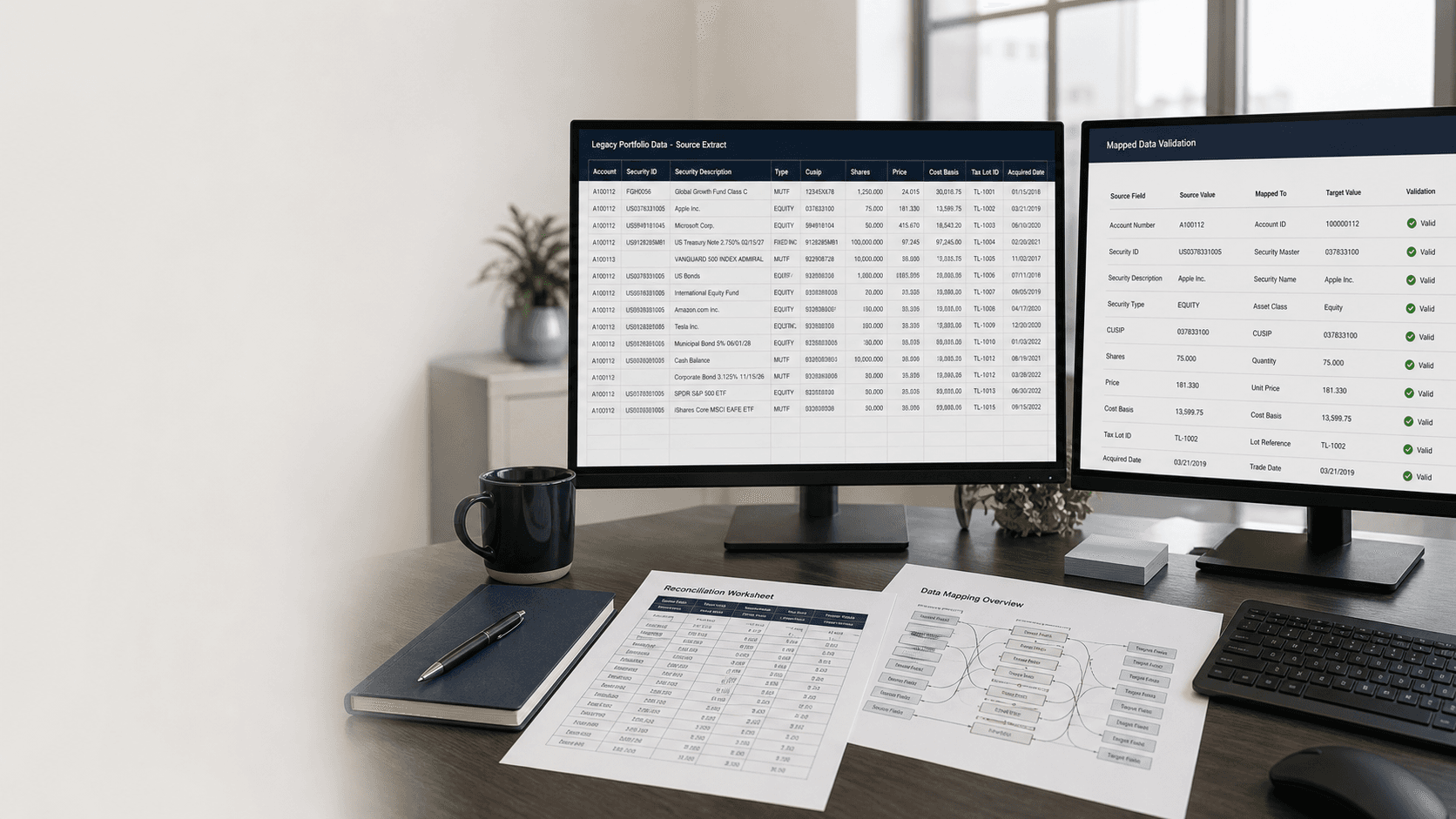
An investment book of record needs a clear definition of positions, cash, transactions, and timing for the workflow it supports. Map those requirements to the accounting book of record and the other systems your team uses. CSSI can review the portfolio data, mappings, reconciliation, and reporting dependencies behind that specification.
An ownership map for positions, cash, transactions, and historical records
Explicit treatment of timing, corrections, and source differences
Sample acceptance checks across the accounting and investment views
From a CSSI customer engagement
See data feeds, reconciliation, and reports working together
A published CSSI engagement describes moving a Trust 3000 client's reconciliation process to CyGem, using CSSI data feeds and custom reporting. It illustrates an agreed operational scope; each firm needs its own review.
Define the book of record by the job and time it supports
Investment book of record
An IBOR supplies the investment view a firm needs for decisions and operating workflows. Define whether that view includes pending orders, executed trades, allocations, expected cash, corporate actions, and other intraday activity. The provider's supported fields and timing determine what the view can reliably represent.
Accounting book of record
An ABOR supports the firm's approved accounting records and related reporting. Specify positions, cash, transactions, cost basis, valuation dates, historical coverage, and close controls for your environment. Record how the investment view relates to this source and how differences will be investigated.
How to unify investment data across systems
Start by naming the source of each record and the meaning of its reporting date. Map identifiers and transaction states, define refresh and correction handling, and compare a sample through both workflows. A single platform and a connected set of systems each need clear responsibility for maintaining approved records.
IBOR and ABOR checklist
Investment book of record vs accounting book of record
Use these questions to define the views your firm needs. Product definitions and supported timing vary, so agree the rules with the responsible system providers.
Scroll across to review all three columns.
Investment book of record vs accounting book of record
Record or control
Define for each source and view
Compare in the sample
Positions and identifiers
Account, security, portfolio-group, and classification sources, including stable matching keys.
The intended account and instrument resolve consistently across the investment and accounting views.
Transaction timing
Order, execution, allocation, trade-date, settlement, and posting treatment where supported.
Differences can be traced to the agreed transaction state and cutoff rather than an unexplained total.
Cash
The records used for actual and expected cash, currency, fees, contributions, and withdrawals.
Each cash figure has an identifiable basis, source, and date for its intended use.
Corrections and corporate actions
The source of cancellations, corrections, and corporate-action records, with replay and review rules.
The correction reaches each dependent view without duplicate or missing activity.
History and valuations
Historical coverage, valuation sources, as-of dates, and any manually maintained records.
Balances and reports tie to agreed references, with stale or excluded values identified.
Reconciliation and approval
Comparison sources, tolerances, exception owners, and the review required before a view is released.
Differences have an explanation and owner, with the firm's acceptance or release decision recorded.
Example scope
Two cash figures use different transaction cutoffs
Illustrative workflow: an investment view reflects an executed trade and expected settlement cash. The accounting report uses a different posting cutoff. The two cash figures differ, and staff manually overwrite one so the daily report appears to tie.
Document the transaction state, cutoff, and intended use of each figure. Trace the trade and cash records to their sources, then identify timing differences and actual processing errors separately. Agree which figure belongs in the report and how operations will review exceptions before changing a data feed or report calculation.
Project outputs
Scope the work around useful deliverables
Record ownership and timing map
Name the source, identifiers, transaction states, refresh timing, and approval responsibility for each required view.
Comparison and exception rules
Define reference outputs, accepted timing differences, material processing errors, review owners, and release checks.
A defined data or reporting change
Scope mapping, conversion, repair, source connections, or report work using the agreed sample and acceptance criteria.
First project
Start with a defined workflow
Choose the operating view.
State the decision or report the book of record supports and the accounts, records, dates, and transaction states it needs.
Map sources and timing.
Identify record owners, identifiers, posting rules, refreshes, corrections, and dependencies between the views.
Trace a sample difference.
Compare source positions, cash, and transactions. Separate supported timing differences from mapping or processing errors.
Agree the data work and review.
Define the repair, integration, migration, or reporting scope CSSI can support and the firm's acceptance responsibilities.
Ridgeline's A Single Book of Record article discusses the relationship between investment and accounting records and the integration work between systems. SS&C Advent's APX product brief describes its portfolio-accounting and reporting scope.
Use the current product specification and your firm's operating rules to define the required view. This page offers a data-review framework, not a CSSI IBOR product or a claim of compatibility with every platform.
Questions
Frequently asked questions
Straight answers to the implementation, workflow, and fit questions that usually come up first.
What is an investment book of record?
It is the defined investment view of positions, cash, and activity used by a firm for decisions and operating workflows. Specify the included transaction states, source records, refresh timing, and validation responsibilities with the system provider.
What is the difference between IBOR and ABOR?
An IBOR supports the required investment view, while an accounting book of record supports approved accounting records and related reporting. Their figures may use different transaction states or cutoffs. Define those rules before deciding that a difference is an error.
How can CSSI help with book-of-record requirements?
CSSI can review portfolio sources, identifiers, mappings, history, reconciliation, data conversion, and reporting dependencies. The team should confirm any new connection or platform capability during scoping.
Should an IBOR and accounting report always show the same cash?
Compare their definitions first. Expected settlement cash and an accounting figure with another cutoff may legitimately differ. Trace the source transactions and timing, then investigate differences that fall outside the agreed rules.
Next step
Discuss a defined project with CSSI
Bring the investment and accounting views that do not agree. CSSI can review sources, timing, identifiers, and reconciliation requirements and define the data or reporting work needed.