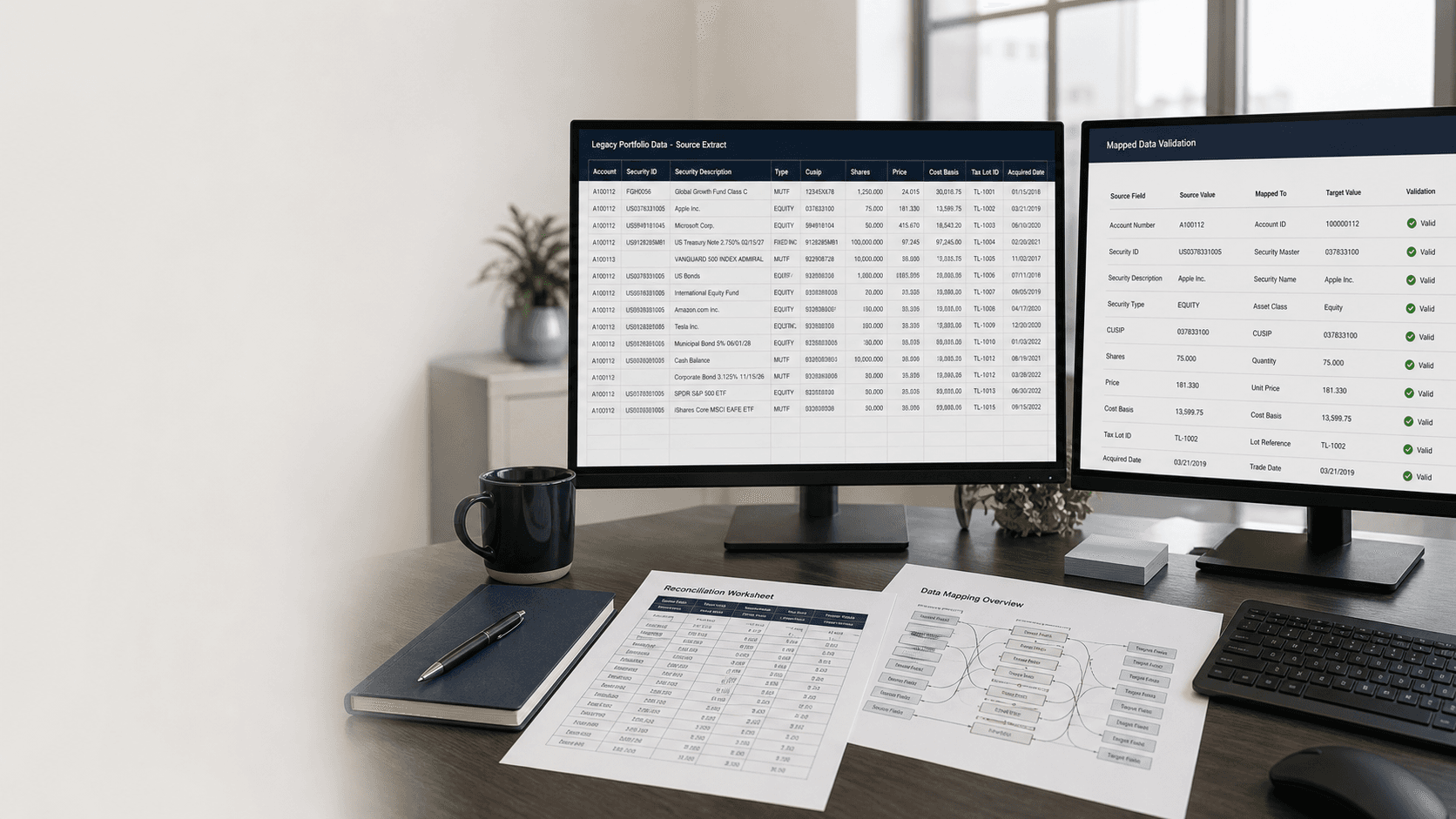
CSSI helps investment firms manage the financial data behind portfolio accounting and reporting. Define the sources, account and security relationships, historical detail, and validation work your systems need. We support focused data repair, integrations, acquired-book merges, and migration projects.
Account, security, transaction, valuation, and tax-lot data work
History and relationships checked alongside current totals
A defined project around the dataset and operating workflow you need
From a CSSI customer engagement
A conversion built around the firm's actual workflows
CSSI's published Axys-to-Orion engagement covers a conversion with sleeve structures, complex billing, and dependent reports. Review the project context when defining what your own system change needs to preserve.
Financial data management for the portfolio workflow
Investment data management connects source records with the accounts, securities, classifications, and history used by the portfolio system. CSSI analyzes, transforms, merges, and reconciles that data. A project can address one damaged dataset or a wider change in how the firm maintains its operating records.
Start where the inconsistency affects the business
Examples include an acquired account mapped to the wrong household, missing historical transactions, inconsistent classifications, or cost-basis detail that does not survive a move. Identify the affected reports and operational work before choosing a repair or integration. The firm should name the source of record and approve the resulting dataset.
Data requirements
Specify the records and checks your dataset needs
Use this inventory to scope financial data management in an investment environment. Current balances alone do not prove that history and relationships are usable.
Scroll across to review all three columns.
Specify the records and checks your dataset needs
Data requirement
Define with the source owner
Acceptance evidence
Accounts and ownership
Source identifiers, target accounts, household or entity groups, and changes over time.
An approved mapping and an account inventory with missing or duplicated records explained.
Security identifiers and classifications
Identifier precedence, naming, asset classes, sector mappings, and effective dates.
Representative holdings resolve to the intended securities and reporting groups.
Historical samples and control totals agree with the reference; unsupported records have a documented treatment.
Prices, valuations, and currency
The source, as-of date, units, currency basis, and responsibility for stale or missing values.
Valuation checks use the agreed basis and identify open differences before reporting.
Tax lots and cost basis
Required lot detail, acquisition dates, adjustments, and the available source evidence.
Sample lot-level records match the approved reference or have an agreed reconstruction scope.
Ownership and change control
Who supplies, changes, validates, and approves each record type and how corrections reach downstream systems.
A maintained mapping, validation record, exception list, and named ongoing owner.
Example project
An acquired book with accounts that already exist in APX
Illustrative workflow: a firm acquires a book whose source system uses different account and security identifiers. Some clients already appear in APX. Importing every source record as a new account can create duplicates and make historical client reports difficult to compare.
Begin with an overlap inventory and approved source-to-target mappings. Decide which records are new, which extend existing history, and which need review. Compare transactions, holdings, and representative reports after the merge. Retain the mappings and unresolved items so future updates use the same rules.
Project outputs
Scope the work around useful deliverables
Source and relationship map
Agree the account, security, transaction, and classification relationships the project must preserve, along with the history to retain.
Validation and exception record
Specify sample comparisons, control totals, open-item owners, and the evidence the firm requires before accepting the dataset.
Maintenance or transition plan
Define correction handling, recurring refresh responsibilities, or the migration handoff so the same problem does not return with the next file.
First project
Start with a defined workflow
Choose the affected dataset.
Name the records, source systems, required history, and operating output that needs to change.
Agree mappings and references.
Resolve identifier precedence, relationships, data coverage, and approval responsibilities before transformation starts.
Repair or transform a representative sample.
Compare current and historical records with agreed source evidence. Record missing inputs and differences before extending the work.
Validate the operating result.
Review the dependent reconciliation, reports, and refresh process. Accept the scope and ongoing ownership before treating the dataset as operational.
Connected services
Choose the support the project needs next
Custodian data aggregation
When the missing input is a recurring source connection, assess feed coverage, mappings, and refresh timing. Review aggregation requirements.
Portfolio data migration
For a platform move, scope extraction, history, validation, and cutover as a separate transition project. Explore migration services.
Investment reconciliation
Connect data preparation with the recurring cash, position, and cost-basis checks the operating team needs. Explore reconciliation support.
Source context
Data delivery still needs a defined operating workflow
The Advent Data Solutions overview distinguishes custodial, corporate-action, benchmark, and other portfolio data services. Use the required record types and destinations to define your project. CSSI's work should be scoped around the source coverage, transformations, and validation your firm needs.
Questions
Frequently asked questions
Straight answers to the implementation, workflow, and fit questions that usually come up first.
What is investment data management?
It is the work of sourcing, mapping, maintaining, and validating the records used by portfolio systems and their reporting workflows. The scope includes the relationships and history behind accounts, securities, transactions, prices, and other required data.
What investment data management services can CSSI provide?
CSSI supports data analysis, transformation, merging, reconciliation, historical repair, cost-basis work, and portfolio-system integrations. The team reviews the source records, target environment, required output, and acceptance checks before confirming a project.
Can we fix a dataset without replacing the portfolio system?
A project can focus on one dataset, mapping, classification, historical gap, or source feed in the existing environment. A replacement is a separate decision. First identify the source of the inconsistency and which outputs depend on it.
How is this different from financial data aggregation?
Aggregation brings data from multiple sources into a usable delivery path. Investment data management also covers how records are mapped, corrected, maintained, and validated inside the operating environment. Some projects require both.
Next step
Discuss a defined project with CSSI
Share the systems, record types, historical coverage, and output that need attention. CSSI can review the data work, dependencies, and acceptance checks for a defined project.